
Jenkins County Arrest Warrants Explained
A Jenkins County arrest warrant is a court order, not police paperwork. A judge must sign it. Under O.C.G.A. § 17-4-40, a judge of a superior, state, city, or magistrate court may issue one on probable cause drawn from sworn information. Probable cause means a sound factual basis to believe an offense occurred and that the named person committed it. Where a case starts depends on the charge. Magistrate Court takes warrant applications and preliminary proceedings. Superior Court handles felonies. State Court covers misdemeanors. Millen Municipal Court takes city traffic and ordinance cases. Cases can also be bound over, so in Jenkins County the court that first received an application may not hold every later docket entry.
Probable Cause Starts Jenkins Arrest Warrants
In Jenkins County, a warrant request usually rides on a complaint or affidavit, a sworn statement of facts laid before a judge. The judge reads it and weighs legal cause. The official Georgia Courts warrant publication reproduces the state framework. It backs the careful wording that a judge may issue an arrest warrant after review, not that police or the sheriff issue one themselves. Once signed, a warrant authorizes arrest. The accused keeps the right to contest the charge. An unserved warrant is not automatically void just because time passed. Its current force rests with the issuing court. Confirm status there before treating the paper as spent.
Inside a Jenkins County Arrest Warrant
A Jenkins County arrest-warrant file has a public side. That portion may name the process and tie it to a court case, and Georgia's magistrate clerks say these files can include applications, affidavits, law-enforcement reports, evidence, and the original warrant. Access still varies. It depends on the record holder, case stage, sealing, juvenile rules, and law-enforcement exemptions.
| Warrant or case number | The identifier assigned by the court or agency; no Jenkins public format is published. |
|---|---|
| Named subject | The person the judicial order authorizes officers to arrest. |
| Charge or offense | The alleged conduct stated in the process, not a conviction. |
| Issuing judge and court | The judicial officer and court that approved the process. |
| Date issued | The date the judicial authority was entered. |
| Bond or hold | Release terms when set; Jenkins County publishes no general bond schedule. |
| Service or return | Whether process was executed or returned with a service result. |
Ask for a file by its real case number. The Jenkins County clerk then decides which parts can lawfully be released.
Jenkins County Arrest Warrant File Terms
A Jenkins County warrant file passes through many hands. Knowing a few terms helps you ask a precise question without mistaking one record for the whole case.
- Application
- The request presented to a judge for judicial review.
- Affidavit
- A sworn statement supporting the request with facts.
- Original warrant
- The signed judicial process, which may transfer when a case is bound over.
- Return
- The report sent back to court stating whether and how process was served.
- Sealed or restricted
- Material withheld due to a court order, statute, juvenile rule, or other exemption.
- First appearance
- The initial judicial appearance after arrest, with timing and bail controlled by court rules and the case.
The clerks' handout cites a ten-year retention reference. That reference covers arrest and search warrant files. Retention does not promise public access. An exemption or a sealing order can still limit what a Jenkins County clerk releases.
Serving Arrest Warrants in Jenkins County
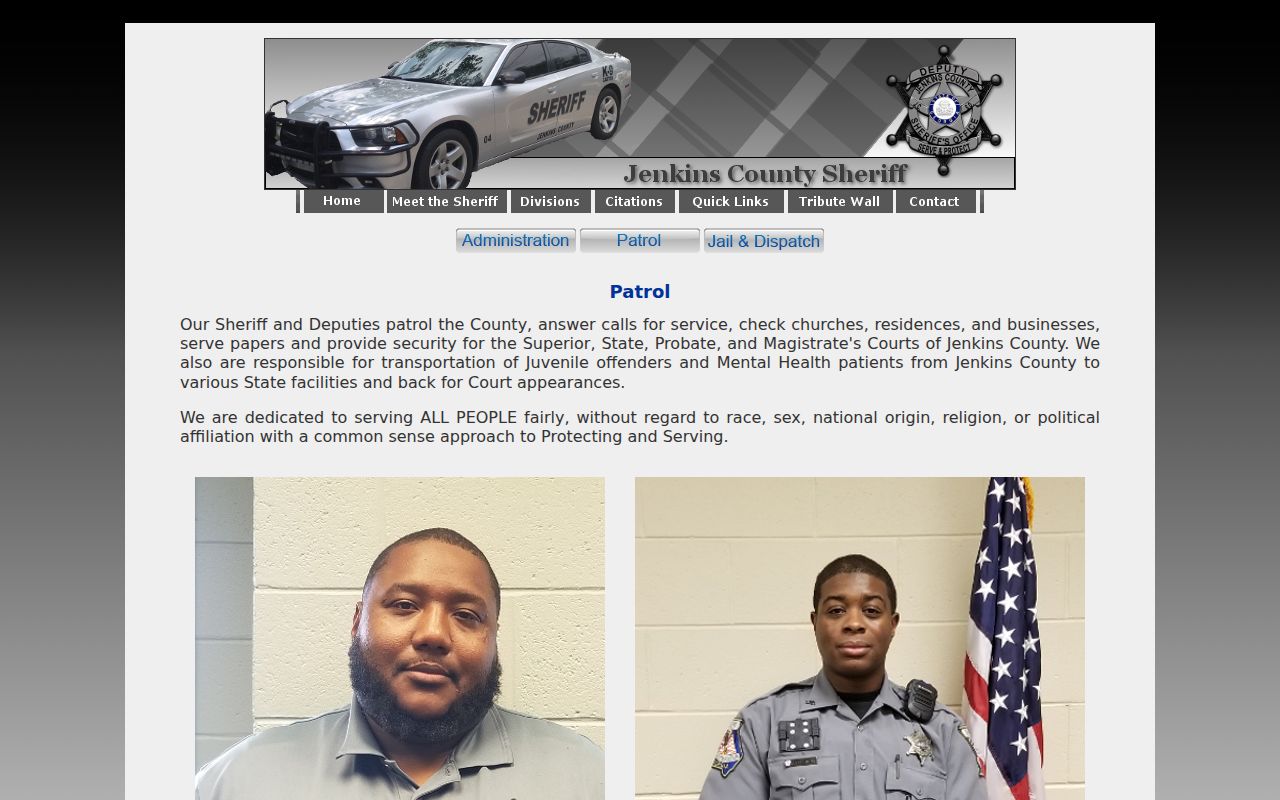
The Jenkins County Sheriff's Office Patrol page describes county patrol, service of papers, court security, transportation, and response work. The main sheriff and jail number is (478) 982-4211. The office posts no warrant-unit page, searchable roster, or warrant-only line. That page shows the agency work behind serving process for the county's courts.
Service work makes the sheriff a practical first call when the issuing court is unknown, though the judge still controls judicial relief. Millen Police runs around the clock. The full-service city agency may execute city process. State and other authorized officers can also receive wanted-person information through criminal-justice systems. GCIC and CJIS carry that data for agencies. No public search taps them for a Jenkins County arrest warrant lookup. A warrant can also surface during a stop or other law-enforcement contact. After arrest, booking, first appearance, and a bail decision follow as the law and the case allow.
Jenkins County Arrest Warrant Service Roles
Jenkins County and Millen split the work. Deputies patrol the county, serve papers, support the county courts, transport people, and work with the jail and dispatch function. Millen Police handles city enforcement and court services. Even so, the issuing court fixes a warrant's legal status no matter which agency serves it.
| Office | Documented role | Public route |
|---|---|---|
| Jenkins Sheriff Patrol | County patrol, paper service, court security, transport | (478) 982-4211 |
| Jenkins Jail and Dispatch | Jail operations and public calls | Main sheriff number and helpdesk email |
| Millen Police | City enforcement and municipal court services | (478) 982-2750 |
| Issuing court | Status, docket, recall, appearance, or bond order | Relevant court clerk |
A paid city citation proves nothing about a county arrest warrant. Start with the paper in hand. If there is none, ask the Jenkins County sheriff to help find the court, then confirm with that clerk.
Comparing Arrest, Summons, and Bench Warrants
Each paper demands a different response. An arrest warrant commands custody on probable cause or other lawful process. A summons just orders an appearance. A bench warrant follows a missed court duty. In Jenkins County, lumping them together can send you to the wrong office or trigger a mistaken payment.
| Feature | Arrest warrant | Summons | Bench warrant |
|---|---|---|---|
| What it directs | Take the named person into custody | Appear at the stated time | Arrest tied to a missed court duty |
| Usual basis | Probable cause of an alleged offense | A case proceeding without initial custody | Failure to appear or comply |
| Response | Counsel, planned surrender, bond if allowed | Attend and answer the process | Ask about reset, recall, or surrender |
| Main authority | Issuing judge and serving agency | Court named on the paper | Judge in the existing case |
The Jenkins County bench warrant search covers that route. Do not treat a summons date or a ticket payment as proof that an arrest warrant changed status.
Find the Jenkins County Arrest Warrant Court
Start with a phone call. The Jenkins County Sheriff and Jail answer at (478) 982-4211, with an alternate line at (478) 982-1570, plus helpdesk@jenkinscountysheriff.com and fax (478) 982-8010. When you do not know which court issued the warrant, ask the sheriff whether staff can confirm the issuing court, a case or warrant number, the charge label, current status, and whether the person must appear or surrender. For Superior, State, or Juvenile files, the Clerk of Superior Court directory shows (478) 982-4683, P.O. Box 659, and weekday hours of 8:30 a.m. to 5 p.m. Jenkins Magistrate Court lists P.O. Box 892 and (478) 982-5580, while Millen Municipal Court takes questions at (478) 982-6100. One caution before you drive: official directories give different physical addresses, some on Harvey Street and some at 611 E. Winthrope Avenue, so confirm the location first. You can also file an Open Records request under the Georgia Open Records Act, O.C.G.A. §§ 50-18-70 through 50-18-78, for existing nonexempt documents. That request cannot force Jenkins County to build a warrant list, open sealed material, or hand over protected pending-investigation and juvenile records.
If There's an Arrest Warrant for You
A blank web result proves nothing. Jenkins County offers no official public sheriff warrant search, and Georgia has no public statewide warrant database, so a empty screen does not mean no warrant exists. Reach a defense lawyer if you can. Then have the issuing court and the sheriff confirm the record, and ask whether counsel can arrange an appearance, a walk-through, or a motion to recall or quash where the law allows it. Arrest warrants normally require custody handling. Never assume paying a traffic ticket clears one. If the court permits voluntary surrender, confirm exactly where and when to report, and bring identification and case information. Expect booking, custody processing, a first appearance, and a bail decision if release is granted. Ask where bond may be posted and what payment or surety the office accepts. Jenkins County publishes no universal bond table, no walk-in schedule, no bondsman directory, and no promise of same-day release.
Act carefully: Speak with counsel and verify surrender instructions because an active Jenkins County arrest warrant can result in immediate custody.
Once the court acts, get a signed order, release, receipt, or docket entry. Ask the court and the sheriff when their records will update, because Jenkins County publishes no shared update schedule.
Restricted Jenkins County Arrest Warrant Records
Not every arrest-warrant document is open on request. Georgia law allows limits for active investigations, confidential sources, private material, court-sealed records, and other exemptions, and juvenile information carries its own confidentiality rules. The record custodian must apply the law to what you asked for, so you may receive a redacted document or no public confirmation at all. The Georgia Attorney General’s Open Government material walks through the public-record framework and helps separate an agency record request from court access. A clerk may hold the court file while investigative material stays with law enforcement. Remember that the Jenkins County Sheriff publishing no public list does not establish that no warrant exists. Keep your request narrow: cite a known warrant or case number, a date range, the court, and the document type. Do not ask an office to compile a new list or infer facts beyond existing records. If access is denied, ask which legal basis applies and whether any segregable, nonexempt portion can be released.
Jenkins County Arrest Warrant Verification
One call may point you to the right agency, but full confirmation usually takes both the Jenkins County court and the serving office. Keep notes so conflicting status details can be sorted out.
- Confirm the exact name and date of birth the agency uses.
- Write down the warrant or case number and issuing court.
- Ask whether the warrant is active, served, returned, sealed, recalled, or quashed.
- Ask whether surrender, appearance, or bond instructions come from the court or jail.
- Request written proof after any judge, clerk, or agency action.
GCIC wanted-person data is restricted to authorized criminal-justice use, and a criminal-history report is a separate product. Federal process is different again. The U.S. Marshals Service and the Southern District of Georgia handle federal matters, not a public Jenkins-specific county roster. Read the jurisdiction printed on the warrant instead of assuming one Jenkins County call covers city, state, and federal systems. Note: A public search gap is an access limit, not proof that no Jenkins County arrest warrant exists.